IJHCI · 2026-01-15 · 已发表
DSPT:用于 VR 交互引导的拆卸序列规划 Transformer
DSPT: Disassembly Sequence Planning Transformer for Interaction Guidance in VR
王子腾: 第二作者
International Journal of Human–Computer Interaction 42(17), pp. 14171-14192 · 10.1080/10447318.2025.2607559
摘要(中文翻译)
虚拟现实已广泛用于复杂设备拆卸训练,而拆卸序列规划与交互式操作引导仍有待深入研究。基于物理碰撞检测的传统方法准确率高,但计算效率难以满足交互需求。近年来,基于深度学习的拆卸序列预测方法推理速度较快,却存在待拆零件预测不准确的问题。本文提出基于 Transformer 的拆卸序列规划网络 DSPT,用于优化拆卸序列并在 VR 环境中引导用户操作。首先,定义拆卸序列特征和零件历史特征及其构建方式。随后,提出基于时空评分的待拆零件概率预测器,并设计利用时空评分的新损失函数来提升预测性能。实验表明,该方法的序列准确率和逐步准确率均优于先进的比较方法。用户研究表明,该方法能显著缩短拆卸任务完成时间,并提高可用性。
英文原摘要
The application of virtual reality technology in complex equipment disassembly training is widely used, and planning the disassembly sequence and interactively guiding the disassembly is an issue that requires in-depth research. Traditional methods based on physical collision detection are very accurate, but the computational efficiency is too low to meet the requirement of interactivity. In recent years, deep learning-based disassembly sequence prediction methods have emerged, which are fast in reasoning but suffer from inaccurate prediction of parts to be disassembled. In this paper, we propose a novel Transformer-based network, the Disassembly Sequence Planning Transformer (DSPT), to optimize the disassembly sequence for guiding users to disassemble objects in VR environments. First, we define Disassembly Sequence Features and Part History Features, along with their construction methods. Then, we introduce the parts-to-be-disassembled probability predictor based on a temporal-spatial score and propose a new loss function leveraging the temporal-spatial score to enhance the predictor’s performance. Experimental results show that our method achieves higher sequence accuracy and stepwise accuracy, both outperforming the state-of-the-art method. The results of the user study demonstrate that our method significantly reduces the disassembly task completion time and improves the usability compared to comparison methods.
用 Transformer 结合拆卸序列特征与零件历史,预测下一个拆卸目标,并把预测用于 VR 操作引导。
逐步物理搜索通常可靠却较慢,直接学习预测又可能给出无效候选。DSPT 研究如何用序列和历史信息提高候选预测质量,服务交互式拆卸引导。
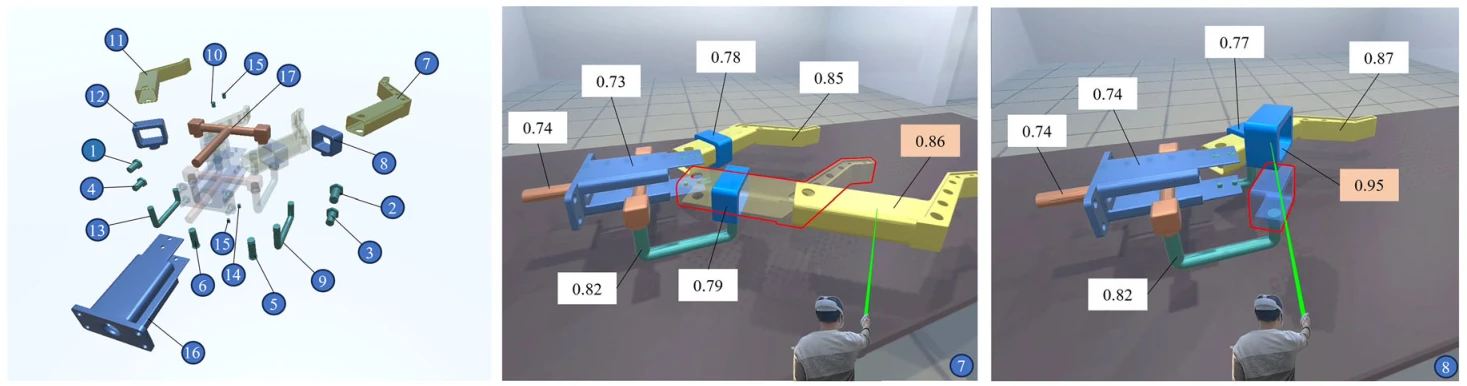
描述当前拆卸过程
构建 Disassembly Sequence Features 和 Part History Features,让模型利用当前序列与零件历史,而不只看单个零件。
学习下一步的候选概率
用 Transformer 预测待拆零件概率,并引入时空评分及对应损失函数改善预测。
在 VR 中引导操作
将候选序列转为用户的拆卸引导,通过序列准确率、逐步准确率和用户任务表现进行评估。
实验与证据
| 评测 | 结果 / 观察 | 解释范围 |
|---|---|---|
| 序列准确率 | DSPT 60.29%;ASAP 50.49% | 论文表 2,测试集差值为 9.80 个百分点。 |
| 逐步准确率 | DSPT 87.68%;ASAP 82.30% | 论文表 2;不等于任意装配体的物理执行成功率。 |
| VR 用户研究 | 16 名参与者,无 VR 使用经验 | 用户在相同实验场景下比较 DSPT 与 ASAP 引导。 |
| 拆卸完成时间 | DSPT 1038.50 ± 55.67 s;ASAP 1246.46 ± 62.42 s | 论文表 4:均值降低 16.68%,仅对应该研究任务。 |
题名、作者与卷期来自 Crossref;方法、图 1、表 2/4、16 人实验及限制均核对了本地出版 PDF 的可恢复正文页面。
适用边界
论文主要在零件较少的物体上评测,复杂或不规则装配体的泛化仍需验证。可见性特征提取带来额外计算开销;该工作没有覆盖拆卸路径规划。因此,候选顺序预测不能替代轨迹可行性、工具约束和真实机器人执行验证。
我的贡献
Ziteng Wang 为出版作者列表中的第二作者。
引用这篇论文
Sichun Huang, Ziteng Wang, Sio Kei Im, Lili Wang. DSPT: Disassembly Sequence Planning Transformer for Interaction Guidance in VR. International Journal of Human–Computer Interaction, 2026. DOI: 10.1080/10447318.2025.2607559
@article{dspt2026,
  title = {{DSPT: Disassembly Sequence Planning Transformer for Interaction Guidance in VR}},
  author = {Sichun Huang and Ziteng Wang and Sio Kei Im and Lili Wang},
  journal = {International Journal of Human–Computer Interaction},
  year = {2026},
  volume = {42},
  number = {17},
  pages = {14171--14192},
  doi = {10.1080/10447318.2025.2607559},
  url = {https://doi.org/10.1080/10447318.2025.2607559}
}